There is definitely some sort of Zen that makes Apple, well, Apple. Taking something obvious, and making it somehow better, somehow cooler, somehow new. How do they do it? By observing how consumers interact with technology and experimenting ad nauseum internally, until they get it exactly the way they want it. This includes abandoning the past if it no longer makes any sense. So when Apple’s own Tim Cook declares that merging a refrigerator and a toaster is not good for the consumer, he may just have a point.
But as forward-thinking as the company is, perhaps Apple hasn’t created a new path at all. Through a technique of observe, perfect and discard, Apple has been heading for some time now in one direction — along the pre-defined path into the era of ubiquitous computing.
Ubiquitous computing defined
In some ways, this path is as logical as Moore’s Law. Look at the history of computing — from the mainframe era where there was one computer for many consumers, to the personal computing era where there was one computer for each consumer, to this new era where there are many computers for each consumer – and compare of the number of computer chips to the number of consumers using those chips. At its foundation, ubiquitous computing could be summed up by this simple principle of ratios.
The modern concept of ubiquitous computing originally came from Mark Weiser in 1988 from the Computer Science Lab at Xerox PARC (sound familiar?). The theory proposed a seamless, almost invisible connection between consumers and computers that would help drive a change in ratios from one computer to many people, to many computers to one person.
Apple’s tabs, pads and boards
Even considering the most radical interpretation of ubiquitous computing dust, the main point has remained the same. We will soon be overrun by computer chips. There are, however, three very distinct platforms in this well-defined post-PC era that we have all become accustomed to. Not unlike the three platforms we see evolving within the iOS platform today:
Gesturing tabs: Mobile technology already had small chips, powerful batteries, geolocation services and wireless networking. But that was not enough to win over the masses and drive us all to purchase multiple computing devices. It was the way consumers interacted with these smaller devices that needed to change. For a long time, it was thought that voice recognition was going to propel us into the next era of computing, but that never happened.
Leveraging the fact that there were approximately 100 million iPod users, Apple was able to use convergence to its advantage as it introduced these iPod users to a series of simple touch-based gestures on a nearly buttonless device. In the early years of the iPod, we all were trained on the scroll wheel. With touch-based gestures on a wide open screen, this paradigm was taken one step further. Just as the mouse accompanied the transition from the terminal-based Mainframe Era to PC era, the post-PC era was ushered in by a new way of interacting with other computer chips, touch.
Revolutionary pads: As soon as people became familiar with this new way of interacting with computers, it was time to challenge the personal computer paradigm directly. Netbooks attempted to continue the personal relationship with consumers by maintaining the 1:1 ratio. Tablets such as the iPad are more specialized and were never meant to be a total replacement for a traditional and general purpose personal computer.
The rapid rise and immediate success of the iPad was proof positive that consumers were ready for a third major computing device in their lives. With “pads” being used by pilots, students and doctors and in restaurants, kitchens and at work, the iPad was proving to be a specialized place-based appliance rather than a personal computer with a more general purpose. As powerful as the third generation iPad is, it will never replace the personal computer, just as the personal computer never really replaced the mainframe.
Experimental boards: The current AppleTV may be a stretch to accept as a computing platform as it has no keyboard, no mouse, no touch display, and just a very simple IR remote. That is unless you happen to be near one with a Mac or iOS device. Then the AppleTV becomes an extension of that device on a much larger screen. Although it is marketed along side the iPod, it is just as closely related to the Airport Express. Perhaps Apple needs to look towards Nintendo’s Wii or Microsoft’s Kinect, otherwise the AppleTV will be doomed as just an accessory to their Tabs and Pads.
Take a look at what HBO has done with the XBox Kinect as an example. If Apple’s recently awarded gesture based patents are any indicator, this may be where it is headed as well. The interaction between consumer and computer chip has not been ironed out enough to fully see this final platform — the boards of ubiquitous computing — take hold of our day-to-day life.
One human relation-chip
Making each device “aware” of how consumers use all of the other devices they own is the key to accelerating the adoption of more than one computing device. While Apple may in fact be the only company in the world to have constructed a homogeneous synergy between its personal and its ubiquitous computing platform, it is certainly not the only company trying to forge the relationship between the user and the computer chip. For the relationship between consumers and computing devices to become truly invisible, these new smart devices will need to know more and more about the consumers who own them. For instance, the devices will need to know everything consumers have done in the past, what they are doing now and even what they plan on doing later.
Perhaps this is the reason Tim Cook stated that Apple’s “best years lie ahead of us.” With technologies like iCloud and Siri, Apple will likely play a larger and larger role in forging the relationship between consumers and the growing number of computing devices in our daily lives. It is not about selling more of these individual devices, it is all about enabling the relationship between an individual and a collection of specialized devices. And Apple knows this.
Related research and analysis from GigaOM Pro:
Subscriber content. Sign up for a free trial.
- Forecast: Tablet App Sales To Hit $8B by 2015
- Social media in Q1: commerce and discovery dominated
- Controversy, courtrooms and the cloud in Q1
Sunday, April 29, 2012
Apple’s inevitable path to a post-PC era — Apple News, Tips and Reviews


Apple squared, (four)squared — Tech News and Analysis
I was down in Soho last week, visiting (of course) the new Manhattan REI store. After the shopping spree, I pulled out my iPhone and found a dinner recommendation on Explore: five of my friends had eaten at La Esquina, several of them more than once. Bingo. I go and get some (delicious and a tad pricy) tacos, and pay the check by giving my full name to the waiter, checking into Foursquare in the process, without ever pulling out my iPhone.
At least part of that story is real, and Apple can make the second part real very soon if they use their $110 billion pile of cash to acquire the two companies that will help them get control of the local point-of-sale market, everywhere. Yes, I am suggesting that Apple acquire both Foursquare (let’s say, at a $1 billion to $2 billion valuation) and Square (currently evaluated at $4 billion, more or less). Paying a premium on both, Apple could keep it at $10 billion between them.
And what does Apple get?
A complete take over — and a true overhaul — of the local point-of-sale market. How much is it worth? Nobody can tell for sure. To give some examples, according to IBISWorld the grocery store market alone is worth an estimated $491 billion annually and convenience stores are a $51 billion market (a subscription is needed to view these reports). As Jason Calacanis wrote recently, if iPhones accounted for one percent of restaurant sales, that would be $6 billion of the $604 billion spent in 2011.
Apple-Foursquare-Square could jumpstart Apple on its way to take over a major part of the transactions in these (and many other) industries. Let’s look at what all three companies get out of this:
Apple gets:
* An immediate presence in the POS market, including merchant relationships. And it will get a platform for local payments that connects to the 200 million strong credit card database the company already has.
* The holy grail of advertising: conversion information. Apple will gain the ability to track customers from search and (even better) iAds to a point-of-sale purchase. We can only imagine how much that’s worth (read: a good chunk of Google’s business).
* Superior local search. Foursquare Explore continues to get better, and it is inherently social — ages ahead of any local search that exists today. Explore has been consistently improving, even outside of such major markets as New York City. If your friends are on (and if they have an iPhone, they will be if after this move), no other service can give you better personalized information about local businesses.
* A development team that is social to the core. Apple has long been accused of lacking “social DNA.” The Foursquare folks could be the seed of social at Apple — even beyond the location sharing — just like Flickr was the seed of social at Yahoo (well, maybe not).
Foursquare gets:
* More checkins and better information. Checkins should be implicit for every single purchase made, creating an immediate personal history. And if you haven’t checked in yet, then there should be an option to “explicitly” check in (i.e. broadcast to friends) when you make a purchase. More data means better recommendations, and it also makes additional services possible, not to mention better user modeling for marketing purposes.
* Easier integration for loyalty, business deals and coupons. Benefits could be factored right into the payment.
* Hundreds of millions of additional users from pre-installed iPhone clients. Additionally, other applications will be able to work with logins and data using device-level integration (similar to Twitter’s integration into iOS).
Square gets:
* 200 million pre-installed devices with credit card details already attached through customers’ Apple Store accounts, i.e. zero client acquisition cost.
* Hundreds of millions of devices equals a great motivation for merchants to sign up.
To summarize: after the deal, Apple will immediately become a giant payments company, with an installation base that is expected to encompass half of all mobile devices sold. The company will have the best local search abilities, far exceeding any existing recommendation engine. And due to its enormous reach, it will possess a payment system that merchants will line up to support. Who’s betting against this holy trinity? Not me.
Mor Naaman (@informor) is an assistant professor at Rutgers University where he directs the Social Media Information Lab. He is the co-founder and chief technology officer of Mahaya.
Image courtesy of Flickr user miamism.
Related research and analysis from GigaOM Pro:
Subscriber content. Sign up for a free trial.
- Connected world: the consumer technology revolution
- Forecast: Tablet App Sales To Hit $8B by 2015
- Social media in Q1: commerce and discovery dominated

Very interesting suggestion. Unfortunately it will not happen. Apple, is by nature, extremely conservative in its acquisitions. This would mark a huge turning point in its direction and would invite the scrutiny of the DOJ.
No, AirPlay Is Not The New Apple TV | TechCrunch

Editor’s note: David McIntosh is the founder and CEO of Redux, a fast-growing video discovery company. Redux is the top downloaded app on Google TV, and you can read David’s other guest posts here.
If you asked your mom or dad what DLNA or UPnP stood for or did, would they just look at you weird? While the two technologies enable users to wirelessly beam content to Internet Connected TVs from their tablets, phones, and computers, Apple’s AirPlay is the first implementation that makes the experience seamless. Tap the button again and playback resumes on your root device. No complicated setup is required – it simply works.
Some, like Bloomberg and Hunter Walk, have suggested that AirPlay is Apple TV, and that Apple will simply license AirPlay to the major Connected TV manufactures – and by default every Connected TV sold will be an “Apple TV” – the remote being your iPhone or iPad. It’s certainly a sensible theory – there are 250 M+ iOS devices, and with the upcoming OS X update, laptops can now leverage Airplay as well. That’s over 300M Apple devices that can push content to TVs.
Fragmentation is the reality
That level of integration would be a dream come true for many networks, studios, and cable companies looking to sell a “TV Everywhere” experience directly to users. Simply integrate with an iOS app, and with one tap consumers can watch content on hundreds of TV devices. Today it’s a big competitive advantage to be able to offer a consistent and incredible TV experience across hundreds of devices. Netflix built its early lead around that competitive advantage, and many networks, studios, and cable companies are looking to build technological solutions to combat fragmentation so that they can compete with Netflix. A content network or studio needs to be able to deliver a discovery and consumption experience better than Netflix’s across just as many devices — otherwise the consumer will turn to Netflix.
A ubiquitous AirPlay integration would level the playing field considerably, but is unlikely for several reasons:
(1) AirPlay adoption is not wide yet. There are less than 5M Apple TV units in the market, which means that today there are less than 5M users in the market that use Airplay for video.
And while Apple is heavily promoting AirPlay-video-enabled apps in the iTunes store, wide consumer adoption is unclear. Unfortunately, stats on Airplay usage aren’t widely available, but anecdotally – in my group of friends I’m the one evangelizing it – many Apple TV owners I meet don’t even realize AirPlay exists.
(2) Manufacturer adoption will be slow. Given that AirPlay does not have a critical mass of users, it’s hard to imagine how in the short-term Apple will convince any of the top five TV manufacturers to adopt AirPlay. Margins on TVs have been decreasing over time, and manufacturers are looking to integrate Connected TVs into an ecosystem of higher-margin tablets and phones. Integrating AirPlay,while it may sell more TVs (when Airplay has critical mass) will reduce sales of higher-margin tablets and phones they could have sold that exclusively interfaced with their TVs.
(3) A seamless experience is unlikely. It’s unlikely video AirPlay would be integrated consistently across all Connected TVs to create the same seamless experience consumers have with an Apple TV today. DLNA is a good example. It’’s an open protocol that in theory should accomplish what AirPlay does, except it’s implemented inconsistently across devices and often doesn’t work at all. Unless Apple has full control of the software layer, simply licensing out AirPlay would not achieve the desired experience.
Apple can overcome the issue of critical mass with enough of its own Apple TV units in the market. But at the pace of sales for its existing Apple TV, it will be years before AirPlay would have the usage to give Apple the clout to get integrations with other manufacturers. That’s why the rumors of an upcoming integrated Apple TV or upgraded device make sense. While AirPlay may be the long-term bet, in the short-term Apple needs a critical mass of users airplaying content to their TV. And AirPlay may be a central part of the rumored AppleTV. It wouldn’t be surprising if Apple uses their new device to train users how to use AirPlay. At that point, AirPlay could become a must-have for other TV manufacturers. As a TV manufacturer you would lose sales by not having it integrated.
But even with a critical mass of AirPlay users in the market, it’s still unclear whether Apple could convince many manufacturers to adopt AirPlay, or would even have success getting them to implement it the way it’s implemented in Apple TV. That’s why Apple owns the hardware and software layer; they can create experiences that would never be created by leaving third-party manufacturers to their own devices.
Winners in TV will have technological solutions to fragmentation
What’s more, a fragmented approach to DLNA and Connected TV has already developed. Just as the Android ecosystem is increasingly fragmented, while iOS is uniform, the Apple TV of the future will be nicely unified with other iOS devices through AirPlay, whereas other Connected TVs will have fragmented platforms with fragmented DLNA protocols.
That means that succeeding in the fast-growing Connected TV ecosystem will require a killer approach to fragmentation. Leading cable companies, and networks looking to sell directly to consumers will have to sit on top of iOS’s uniform AirPlay platform, as well as a highly fragmented Connected TV and DLNA platform to reach meaningful scale.
There’s also the issue of whether or not Apple can strike a deal with Hollywood and other content creators but that’s a story for some other time.
I don't necessarily agree with David's assertion that TV manufacturers won't integrate Airplay into their sets. Many of the top audio gear has already done it so I don't see why TV manufacturers wouldn't (except that many of them are trying, with very little success, to build their own ecosystem with apps). As far as consistent support, Apple has traditionally been very good at enforcing good implementations if the manufacturer is to state that their device is 'AirPlay' enabled. I think this would be a smart route to go but I think the TV manufacturers are reluctant only because they would be ceding the entire app market to Apple by doing so.
The A/B Test: Inside the Technology That's Changing the Rules of Business | Epicenter
.ab_strike { color: #000000; font-size: 1.3em; font-weight: bold; margin-bottom: 5px; text-decoration: line-through; }

Illustration: Si Scott
You have to make choices.
Choose everything.
The online payment platform WePay designed its entire homepage through a testing process. “We did it as a contest,” CEO Bill Clerico says. “A few of our engineers built different homepages, and we just put them in rotation.” For two months, every user that came to WePay.com was randomly assigned a homepage, and at the end the numbers made the decision.
In the past, that exercise would have been impossible—and because it was impossible, the design would have emerged in a completely different way. Someone in the company, perhaps Clerico himself, would have wound up choosing a design. But with A/B testing, WePay didn’t have to make a decision. After all, if you can test everything, then simply choose all of the above and let the customers sort it out.
For that same reason, A/B increasingly makes meetings irrelevant. Where editors at a news site, for example, might have sat around a table for 15 minutes trying to decide on the best phrasing for an important headline, they can simply run all the proposed headlines and let the testing decide. Consensus, even democracy, has been replaced by pluralism—resolved by data.
The mantra of “choose everything” also becomes a way for companies to test out relationships with other companies—and in so doing becomes a powerful way for them to win new business and take on larger rivals. In 2011 a fund-raising site called GoFundMe was talking with WePay about the possibility of switching to its service from payment giant PayPal. GoFundMe CEO Brad Damphousse was open about his dissatisfaction with PayPal’s service; WePay responded, as startups usually do, by claiming that its product solved all the problems that plagued its larger competitor. “Of course we were skeptical and didn’t really believe them,” Damphousse recalls with a laugh.
But using A/B, WePay could present Damphousse with an irresistible proposition: Give us 10 percent of your traffic and test the results against PayPal in real time. It was an almost entirely risk-free way for the startup to prove itself, and it paid off. After Damphousse saw the data on the first morning, he switched half his traffic by the afternoon—and all of it by the next day.

Photo: Spencer Higgins
The person at the top makes the call.
Data makes the call.
Google insiders, and A/B enthusiasts more generally, have a derisive term to describe a decisionmaking system that fails to put data at its heart: HiPPO—”highest-paid person’s opinion.” As Google analytics expert Avinash Kaushik declares, “Most websites suck because HiPPOs create them.”
Tech circles are rife with stories of the clueless boss who almost killed a project because of a “mere opinion.” In Amazon’s early days, developer Greg Linden came up with the idea of giving personalized “impulse buy” recommendations to customers as they checked out, based on what was in their shopping cart. He made a demo for the new feature but was shot down. Linden bristled at the thought that the idea might not even be tested. “I was told I was forbidden to work on this any further. It should have stopped there.”
Instead Linden worked up an A/B test. It showed that Amazon stood to gain so much revenue from the feature that all arguments against it were instantly rendered null by the data. “I do know that in some organizations, challenging an SVP would be a fatal mistake, right or wrong,” Linden wrote in a blog post on the subject. But once he’d done an objective test, putting the idea in front of real customers, the higher-ups had to bend. Amazon’s culture wouldn’t allow otherwise.
Siroker recalls similar shifts during his time with the Obama campaign. “It started as a pretty political environment—where, as you can imagine, HiPPO syndrome reigned supreme. And I think over time people started to see the value in taking a step back and saying, ‘Well, here’s three things we should try. Let’s run an experiment and see what works. We don’t know.’”
This was the culture that he had come from at Google, what you might call a democracy of data. “Very early in Google’s inception,” Siroker explains, “if an engineer had an idea and had the data to back it up, it didn’t matter that they weren’t the VP of some business unit. They could make a case. And that’s the culture that Google believed in from the beginning.” Once adopted, that approach will beat the HiPPOs every time, he says. “A/B will empower a whole class of businesses to say, ‘We want to do it the way Google does it. We want to do it the way Amazon does it.’”
Says WePay’s Bill Clerico: “On Facebook, under the heading of Religious Views, my profile says: ‘In God we trust. All others, bring data.’”
Saturday, April 28, 2012
A father's lament: The real world is not a game | Internet & Media - CNET News
There was something about the Mama Bear family tech conference a week ago that creeped me out. I am the father of a 5-year-old boy, and perhaps a third of the people at this conference were trying to build apps for him. All the apps were well-intentioned. All were, at some level, educational.
Still, all the apps felt wrong to me. I wanted my son to have nothing to do with any of them.
I've been trying to understand why these educational apps were getting under my skin to this extent. It's not like I'm anti-technology when it comes to my child. He plays Angry Birds. We watch TV (together). He's a child of technology; how could he live in my house and not be?
A psychiatrist friend, listening to me rant about how these apps are trying to wilt my son's brain, sympathized, but not completely. Yes, he said, computer games can be addictive. In fact, in his opinion, teaching kids to expect the world to work like a computer game deprives them of learning real-world life skills.
But, he said, a truly good educational app can be effective like a book, or a teacher. You can't stick everything that pops up on a kid's iPad into the "evil" category.
So where are the really good apps?

The Vinci Tab II is an Android tablet preloaded with educational software for kids up to 5 years old.
(Credit: Rafe Needleman/CNET)A few days ago, I handed my son a Vinci tablet to try out. This is another well-intentioned product for young children. It comes with pre-installed educational games carefully geared to kids up to about my son's age (actually he's a little old for it, but I occasionally make him earn his keep as a product reviewer).
I had the same feeling of foreboding about this product as I did about many children's apps I see. The Vinci reinforced this, unfortunately. While the game did in fact have educational payloads, the mechanics were, for the most part, dumb. How does pressing a button at exactly the right time to jump over a beach ball on-screen teach anything but how to operate a game, no matter what the game says it's supposed to be about?
The boy liked the tablet and its apps. But it's how he liked them that bothered me. The software sucked him in, and whatever lessons it tried to teach him were obstacles that seemed about as interesting as the flatly drawn beach balls. The real red flag came when I told my boy it was time to put the tablet down. He was so dialed in to the game mechanics that he panicked. He wasn't in learning mode, he was in addiction mode.
Did he retain the factoids and basic math and spelling skills he learned while playing? I think so. But I don't want him learning this way.
There is hope, though.

On the DIY app, kids snap pictures of their projects. On the Web site, shown, family and friends can award badges.
(Credit: Screenshot by Rafe Needleman/CNET)Yesterday, I read about the launch of DIY, a site and app for kids that's supposed to be a social destination for them to share their creative projects. They upload photos of stuff they've designed, built, written, or drawn, and then their friends and family members can award them badges.
Something about this site appealed to me as a father. Why was it better than all the learning games, with their impressive educational pedigrees? I couldn't put my finger on it. So I called up DIY's CEO, Zach Klein (formerly of Vimeo). Klein isn't a father himself, but he understands the child's mind. In a few words he crystalized for me what I find distasteful about most kids' programming.
"They are gravity-fed," he says. "There's a path of least resistance to get to the next screen." The player's job is to find that path, he says. Games like this "infantilize children."
The real world doesn't work like this. There are no shortcuts in life. You don't get a big reward for each tiny action. Real rewards take real work.
Related stories
DIY, he says, "gives children more responsibility than they are used to, not less." And the rewards aren't programmed. They come from peers and family. "We want kids to feel satisfaction, but we're suggesting it will take time and craft and love to earn it."
DIY is in a very early stage, and is too basic at the moment. In the interest of protecting kids, there's no personal information anywhere on the system; kids' identities are masked behind handles, and if a family member awards a kid a sticker, the kid can't see who it came from. But the thinking of DIY is right, at least to me: Encourage kids to engage with the real world. Use social-networking mechanics to reinforce it.
I loaded the DIY app on to my old iPhone 3G. I plan to let my boy use the app on this device without supervision. It's the first app I've seen that passes that test for me. I'm not sure he'll use it, but I bet he will. And I like it, because it's an accessory to his physical world, not a replacement for it.
This is an excellent article if you are interested in educational games for your kids. The best line is the description of most games:
"They are gravity-fed," he says. "There's a path of least resistance to get to the next screen." The player's job is to find that path, he says. Games like this "infantilize children."
Thursday, April 26, 2012
The Decline Of Android Foretells The Rise Of A Total Apple Monopoly | TechCrunch

I own an Android phone right now as well and completely concur with Matt's assertions around Android.
Tuesday, April 24, 2012
The Art of the Pivot
Very interesting article, with examples, of companies that have successfully pivoted from their original business model. It would be just as interesting to hear of pivots that didn't succeed but alas that would probably not get the same amount of click-throughs:
http://www.inc.com/magazine/20110201/the-art-of-the-pivot.html
Take Charge Product Management © | Advancing the Profession of Product Management ™
The project manager / product manager relationship
Sure we know that effective collaboration leads to improved outcomes and more effective teamwork. But what specific functional collaborations are key in triggering creativity, problem solving, fostering further team communication, and ultimately improving project outcomes? Just putting everyone together in a room at project inception doesn’t necessarily guarantee success.
From my experience, the most successful product development projects were those that had the product manager and project manger tightly coupled from the very beginning. Spending more time developing this relationship from the onset will pay dividends and increase the likelihood of project success.
If we can agree that the goal of a product development project is to create, develop, and deliver a product to the market, maximizing its value – the customer benefit and experience – while ensuring the return on investment (ROI). Then, nothing ensures maximizing ROI more than getting the definition correct at the onset of a project. Knowing where you’re going and how to get there, at the beginning of the life cycle, eliminates waste by avoiding unnecessary course corrections throughout a project.
Leveraging the expertise of project managers at the earliest phases of a project helps to get this definition correct by bringing their best practices and lessons learned to the table at a critical juncture – the start of the project. Engaging project managers early has additional benefits: (1) Project ownership is now ingrained into its leaders because they have helped shape the execution approach; (2) By working together to form the overall project definition in the beginning of its life cycle, the foundation of a team dynamic is put in place that spills over into the rest of the project organization as it is put together.
Product managers and project managers can strengthen this relationship by understanding three fundamental concepts from the beginning of every project:
- The product development and project life cycles are deeply intertwined
- The product’s production process needs to be collaboratively defined with clarification of the major deliverables and resources required to get the job done
- Shared incentives, performance objectives, and success criteria establish common ground for the entire team
Each one of these three concepts warrants its own discussion so I’m going to treat each one of these as separate blog postings. This should allow for more focused commentary allowing the concepts to be completely hashed out.

Monday, April 23, 2012
The Slow Decay Of The Microsoft Consumer | TechCrunch

Five years ago, Microsoft reported revenue of $14.398 billion. They reported a profit of $6.589 billion. Last week, for the same quarter, Microsoft’s revenue was $17.407 billion. Their profit was $6.374 billion. The company is still growing, but not fast. And they’re actually making less money.
Compare that with Apple. Five years ago, revenue was $7.1 billion. Profit was $1.0 billion — the first quarter with a billion dollar profit in company history. Last quarter, the company reported $47 billion in revenue. And they recorded $13 billion in profit.
On the surface, an apples-to-oranges comparison, perhaps. But it points to something that has happened. Apple has completely taken over the consumer market, while most of Microsoft’s growth these days comes from the enterprise side of things. Apple has destroyed Microsoft as a consumer technology company.
Sure, Microsoft is still making plenty of money — billions — off of their consumer goods. But the decent quarterly numbers they reported last week in some ways mask what is really happening: Microsoft is slowing morphing into a full-on enterprise company.
Everyone got all excited that the Windows division actually managed to grow last quarter. Because the broader PC market has been stagnant and Windows 8 is in testing mode, expectations were extremely low. 4 percent growth was considered a big win.
But Microsoft as a whole saw 6 percent growth year-to-year when it came to revenue. It wasn’t Windows driving it, it was the Business Division (9 percent growth) and the Servers & Tools Division (14 percent growth). Again, the enterprise side of things.
The Business Division is now by far the largest Microsoft division in terms of revenue. Meanwhile, Servers & Tools almost surpassed the Windows Division this past quarter. The last time that happened was the tail end of the Vista nightmare. It’s going to happen again. Microsoft’s two biggest businesses will be their enterprise businesses.
Even on the Windows side of the equation, this was the key statement in the earnings release:
Strong Windows 7 adoption continued with enterprise desktops on Windows 7 now up to 40% worldwide.
Nothing about the consumer side of Windows, just the enterprise side. That’s what led to the 4 percent growth surprise.
Windows 8 is due out at the end of the year, and I’m sure the Windows Division revenue numbers will jump as a result. But as these charts by Horace Dediu show, the jump is likely to be short-lived. Microsoft saw a huge revenue (and profit) spike when Windows 7 was released, then it immediately dropped and plateaued. It was back to the revenue grind and the profit stagnation.
Windows 8 could be better for the company, or it could be worse. The world is drastically different than it was even just three years ago. The iPad exists, for one. While Microsoft is going all-in (or at least half-in) on their tablet strategy with Windows 8, there’s no indication it will actually work. If it doesn’t that could significantly hurt the Windows Divisions’ numbers.
Another key difference over the past five years is, of course, the iPhone. Five years ago, no consumer had one. Microsoft controlled nearly 35 percent of the U.S. smartphone market. It was going to be a huge business for them. Today, that percentage stands at roughly 5. And even with Windows Phone, it’s shrinking, as Dan Frommer points out today.
Microsoft’s last-ditch attempt insert themselves into the mobile picture isn’t working. At least not yet.
Consider this: Apple’s iPhone business alone is bigger than all of Microsoft’s businesses combined.
And that matters because again, that’s where consumers are today. Smartphones. Tablets. The PC business is going nowhere. Let’s just admit it: that’s not going to change.
The wildcard is the living room. This is the one consumer space where Microsoft has done better than Apple over the past 5 years. The Xbox 360 has been a big hit, and accessories like the Kinect have moved the market forward. Apple’s first Apple TV was largely a dud. The second one is much better and seems to be selling well, but it’s not a consumer hit in the same way the Xbox is.
But last quarter, a funny thing happened: Microsoft’s Entertainment and Devices Division actually lost money. That had not happened since 2009. And it was the worst loss since 2007 — again, five years ago.
Since Microsoft reports Windows Phone numbers under E&D, some assumed the poor numbers were a result of things like Microsoft’s Nokia payout dragging the division down. But Microsoft themselves noted that the 16 percent decrease in revenue was the result of “a soft gaming console market”. This was later backed up by more numbers. The drop in revenue and the swing to a loss was all about Xbox demand evaporating.
Now, obviously, the Xbox is old — some may say “ancient” by gaming console standards. And a new one isn’t due until next year. That device will undoubtedly do well, but you have to wonder if Microsoft wasn’t surprised by this swift drop to a loss for the division. If they weren’t, why not aim for a new console this year? It sure seems like they were counting on things like the Kinect to extend the life of the device, and that worked for a while, then collapsed.
Meanwhile, gaming on iOS continues to grow. Anyone who doesn’t view the iPad as a legitimate living room gaming contender now is simply fooling themselves. And it’s a device that’s refreshed with the lastest hardware once a year. The Xbox is coming in three, four, or even five year intervals. That simply cannot compete given the rate of change we’re seeing.
Microsoft is smart to move more into the broader entertainment space, securing content deals for the Xbox. But again, Apple will be there as well. At first through the existing Apple TV (with a killer assist from the AirPlay functionality). Down the road, perhaps with their own actual television.
And then there’s the Online Service Division. Despite their “operating loss improvement“, they lost another $479 million last quarter. The total losses for the division over time are approaching $10 billion as they chase Google down a rabbit hole to claim a consumer market they’re never going to win.
To me right now, Microsoft’s consumer business feels like Nokia’s smartphone business a few years ago: the numbers look fine, and in some cases even good, but the world is quickly changing. If you just look at the past five years of what Apple has done versus what Microsoft has done, it’s not hard to imagine Microsoft’s business being completely dominated by the enterprise side of the equation in another five years. That will still make for a great business, but it’s not the Microsoft that many of us have known.
Everyone you know goes away in the end, I suppose.
Learn moreMicrosoft, founded in 1975 by Bill Gates and Paul Allen, is a veteran software company, best known for its Microsoft Windows operating system and the Microsoft Office suite of productivity software. Starting in 1980 Microsoft formed a partnership with IBM allowing Microsoft to sell its software package with the computers IBM manufactured. Microsoft is widely used by professionals worldwide and largely dominates the American corporate market. Additionally, the company has ventured into hardware with consumer products such as the Zune and...

This puts Microsoft's current position into perspective...
Thursday, April 19, 2012

Into The Wild: Lost Conversations From Steve Jobs' Best Years | Fast Company
One way to drive fear out of a relationship is to realize that your partner's values are the same as yours, that what you care about is exactly what they care about. In my opinion, that drives fear out and makes for a great partnership, whether it's a corporate partnership or a marriage.via fastcompany.comSteve Jobs quote from a great article...
Monday, April 16, 2012
Some of Mom's Old Photos
It's great to be able to look at these old photos of my Mom and her family.
Created with Admarket's flickrSLiDR.
Sunday, April 15, 2012
Kids in Victoria - ChatterBlock
Welcome to ChatterBlock!
As a busy parent, finding local events and activities for your kids and family should never be a chore. With ChatterBlock, setting up your clan with great programs, drop in events and camps can be efficient, social and fun!</p> <p>Based in Victoria, BC, ChatterBlock is a social media company built specifically for busy parents. ChatterBlock is a place to discover and learn about activities, resources and events happening in your community, allowing you to connect and share with other families and friends along the way.</p> <p>So, just what can ChatterBlock help you with?</p> <div class="help"> <ul> <li>Discover family-friendly events in Victoria BC and surrounding activities</li> <li>Search and browse a very large selection of programs and camps for your children</li> <li>Find drop-in schedules for all the major recreation centres, in one place</li> <li>Track what activities you’re attending (click I’m In) or short listing (click Maybe)</li> </ul> </div> <p>Share event and program ideas with your family and friends – because as we all know, the more the merrier!</p></blockquote>If you are a parent in Victoria or the San Fran area, this is the site for you! Check it out at http://http://www.chatterblock.com/kids-in-victoria/#
Saturday, April 07, 2012
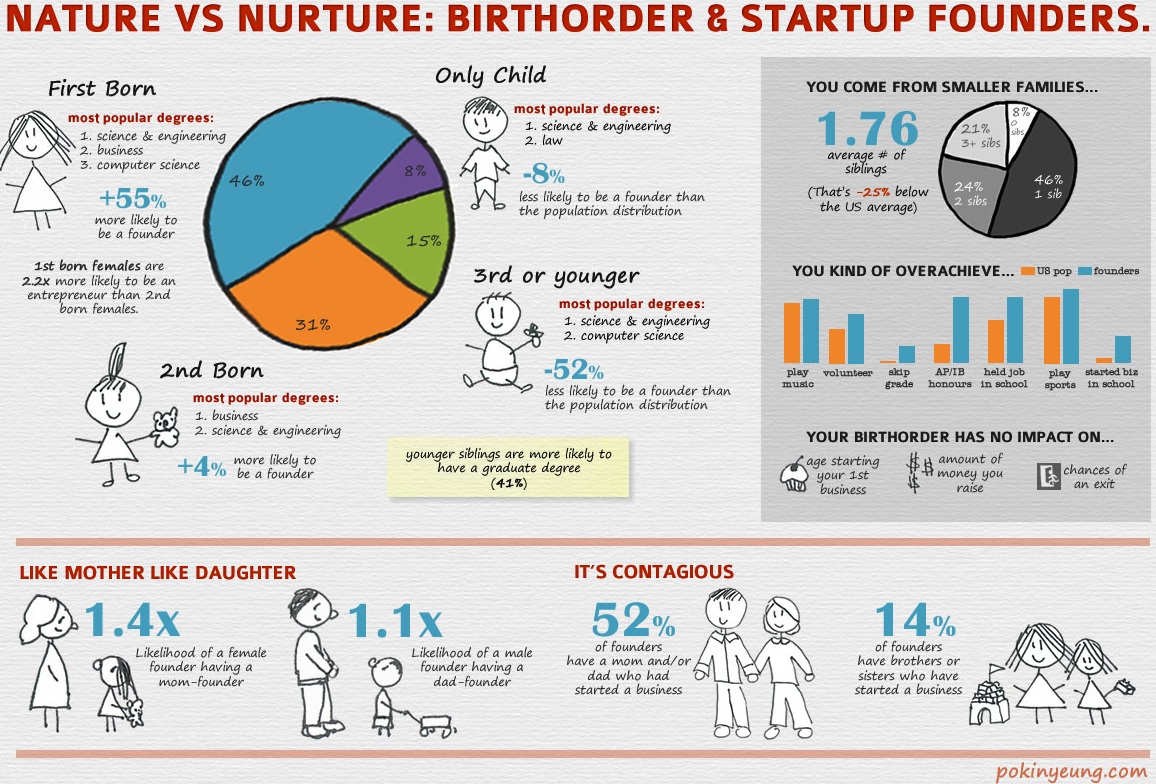
Why You’re A Startup Founder: Nature And Nurture | TechCrunch

Editor’s note: Pokin Yeung founded two startups, GeckoGo and Askomatics, and is currently blogging and helping out various other startups. Follow her on Twitter @pokin.
Just over a month ago, a random conversation with another startup founder over lunch turned into a full-blown research project.
“You and I are both first-born children,” I mused to my friend, “I wonder if that had any influence on why we chose to start businesses.”
I theorized that first borns were often given more responsibility growing up, and wondered if this role served as training wheels for building startups. I also wondered if our upbringing had an influence on things like when we start, what we start, or how much money we raise — and ultimately, how successful we are with our businesses.
Four weeks, a survey of 318 founders, and a lot of data-crunching later, here are my conclusions:
Family Matters
- Your birth order does influence the likelihood you will be a founder.
If you’re a first-born, you are more likely to be a founder — 55 percent more likely than the population distribution. Just under half (46 percent) of our founders were first-born children, and I fit into this category. If you come from a two-child family, this effect is larger. You’re 63 percent more likely to be a founder than the second born child.- If you’re female, this effect is huge.
Female first-borns are 118 percent more likely than second-born females to be founders if they come from a two-child family. I fit into this category, too. Maybe the capricious nature of sibling relationships combined with the leadership (read: guess-who’s-in-trouble-if-something-happens-to baby-sis) role gives us more comfort in the rock-and-roll world of starting companies.- Second-born children are slightly more likely than the general population to be founders, but beyond that the chances actually decrease.
- Third-born or later children are 52 percent less likely to be a founder.
- Only children are underrepresented, and it’s statistically significant. Only children have been described as “First Borns on Steroids.” They are typically more likely to become CEOs and be hyper-achievement oriented. Yet they are underrepresented in our study. Could it be that only children prefer to rule larger, more established companies? Or is it something about the uncertain dynamic of having siblings to fight with that gives first borns the skills and motivation to take the leap?
- There is no correlation between your birth order and your chance of raising money or having a successful exit.
Startups run in the family
The data suggest that your parents can shape your inclination to become a founder – especially if your mom was an entrepreneur and you’re a girl. Female entrepreneurs are 1.4 times more likely to have a mom who was also a founder. Over 50 percent of our founders surveyed have a parent who had also started a business, and 14% of respondents have a brother or sister who’s taken the leap. So it seems having a good role model matters — especially for females. Organizations like Women 2.0 are a good start, and more access to mentorship programs during the formative years could make a big difference in bringing more female founders into play.
Higher education or trial by fire?
Startup founders have to do a lot of multi-tasking, but two things that don’t seem to mix are school and startups. Most founders tend to wait till school is done before starting their first business. In general, by the time founders are 25
- 74 percent of you had started a business if you didn’t have a college degree.
- 55 percent if you had a bachelor’s degree.
- 24 percent if you had a graduate degree.
Also, 50 percent of you waited till after 30 to start your first business if you had a graduate degree.
How else do you compare against the population? For starters, you overachieve.
Startup founders in general tend to overachieve. You are 6.4 times more likely to have skipped a grade, and 6 times more likely to start some sort of business endeavour (selling candies, anyone?) while still in school. Across the board, startup founders are more likely to more likely to do things like play sports, play a musical instrument, or hold a part-time job while still in high school. Maybe it’s a desire for learning, general well-roundedness and drive for growth that creates the motivations for founders to strike out on their own? Or maybe it’s a curiosity about the world. Lots of potential theories and areas of further research.
So what next?
The specific circumstances that push founders to take the leap definitely involves more than the sequence in which founders arrive to their families, but it does seem clear that once you become a founder, you stand to quite strongly influence future generations to come.
There were other interesting areas of research, including the types of adversity faced by startup founders growing up, and it’s what I want to dig into next. If anyone is interested who didn’t participate in my study before, I’d love to ask you some questions here.
Monday, April 02, 2012
AmEx Swipes Neal Sample From eBay for Digital Payments Push - Tricia Duryee - Commerce - AllThingsD
American Express has lured Neal Sample away from eBay to become SVP of technologies for its digital payments initiative.
Called
Serve, it is competing head-on with eBay’s own PayPal, as American Express attempts to expand its audience beyond briefcase-toting corporate users.
At eBay, Sample was the CTO of X.commerce, the open commerce platform the company unveiled late last year that gives technology tools to retailers at no cost. Prior to eBay, Sample was a senior executive at Yahoo, where he led the open, social and participation platforms. He left Yahoo in August 2010.
Sample’s technical expertise is focused on developing and building platforms and products for emerging technologies.
Serve is a complex platform that allows consumers to make purchases, take cash withdrawals from ATMs and make person-to-person payments from their computer or their phone.
The offering is fairly complex because it can be funded by a user’s bank account or credit or debit card — even from one of the company’s major competitors, like Visa or MasterCard.
In the future, American Express envisions expanding the platform to mobile phones, using near field communication or other technology.
Given eBay and PayPal’s extensive knowledge in the digital payments arena, many of its executives have left the company to explore the endless number of opportunities sprouting up.
Recently, Alyssa Cutright, a 12-year veteran of PayPal, left to join Square, a payments company in San Francisco; and of course, PayPal President Scott Thompson left at the end of last year to join Yahoo as CEO. Last week, eBay named David Marcus as his replacement.
Sunday, April 01, 2012
Chrome Multitask Mode
Saturday, March 31, 2012
Thursday, March 29, 2012
10,000 Year Clock

Checkout this pretty out there project that Jeff Bezos is involved in. It is amazing in it's scope.....
Wednesday, March 28, 2012
Lobbyists, Guns and Money - NYTimes.com
Elephant Plays with a Galaxy Note! - YouTube
This is not a fake. Think of what this elephant could do with an iPad!
Tuesday, March 27, 2012
Latest BlueStacks ARMs your PC | The Download Blog

Angry Birds Space running in the BlueStacks beta app player for Windows.
(Credit: BlueStacks)The BlueStacks app player for running Android apps on Windows has taken a major step forward today with the release of its first beta, which can run even graphics-intensive Android apps on desktop PCs.
The BlueStacks beta (download) leverages a new, patent-pending technology that the company has developed called LayerCake, which does two things necessary for running Android apps on Windows. First, it powers the app on hardware that it wasn't originally intended to run on. That's basically the ARM to x86 conversion which runs the apps, and it comes with the blessing of one of AMD's head honchos.
"LayerCake is a disruptive technology that enables PC manufacturers to bring the best of the Android ecosystem to their customers. We are excited to work with BlueStacks to make the emerging Android mobile apps market part of the broader computing arena," Manju Hegde, corporate vice president, Content, Applications and Solutions at AMD, said in BlueStacks' statement announcing the new beta.
LayerCake also includes hardware graphics acceleration that wasn't available in last year's BlueStacks alpha. This means that it uses your PC's graphics card to make graphics-intensive apps, including Android NDK games like Air Attack HD, run more smoothly. "It's actually quite similar to the hardware acceleration in your browser," BlueStacks CEO Rosen Sharma said during a phone call with CNET yesterday.
There's more to LayerCake's hardware acceleration than that, though. It also can replicate accelerometer tilting in apps that utilize it via the mouse or arrow keys. Pinch-to-zoom is also supported on mouse trackpads.

Air Attack HD running in the BlueStacks beta app player for Windows.
(Credit: BlueStacks)BlueStacks saw enormous success during its brief, three-month long alpha test last year. "We had more than one million downloads in three months," said Sharma, who added that BlueStacks traffic equaled one-sixth of the Kindle Fire purchases during the same period. "It's possible that two months from now, we'll become the largest Android deployment on large screens," he said.
This beta debuts a significantly changed program. You can download apps directly from within BlueStacks, without using an Android phone, and it comes with a dock launcher that fits naturally with the Windows interface. Using BlueStacks' Cloud Connect feature for syncing apps, you can now send and receive text messages on your PC. There are plans, Sharma said, to expand it to include more of your phone's notifications, too.
Android apps such as Angry Birds, which cost money for their PC versions, can now run on your PC. So if the Android app is free, then you can run it on your Windows box for free, too. The multitude of simple photo editors are another example of Android app that BlueStacks can run on your PC. I'm not sure the world wants the Android version of Instagram on Windows, but chances are somebody will dig applying those filters to the photos saved on their desktop.
"This is a leveling of the playing field," said John Garguilo, BlueStacks' vice president of marketing and business development.
You can also run apps in either windowed or full-screen mode, and BlueStacks now comes localized for 12 non-English speaking countries including Korea, China, Germany, The Netherlands, Brazil, Japan, Argentina, Mexico, Spain, France, Italy, and Russia. Localization goes beyond translation, and includes region-specific apps. So, KakaoTalk will come with the Korean version of BlueStacks; Germans will get eBuddy; WhatsApp comes to the Spanish-speaking countries, and China gets Weibo.
Among the numerous pre-installed Android apps on BlueStacks for English-speakers are Fruit Ninja, StumbleUpon, and Evernote.
Monday, March 26, 2012

How Japan's Biggest E-Commerce Company Plans To Take Over The World - Yahoo! Finance
Japan hasn't had a single Internet company breakout to become a global success story.
Hiroshi Mikitani, the CEO of e-commerce site Rakuten, is hoping to change that.
He's gone on a shopping spree in the last few years to make it happen. He bought Buy.com in the U.S. for $250 million, Play.com from the UK for $38 million, and e-reader company, Kobo for $315 million. (There are other acquisitions, but the company was particularly excited about these three.)
To make all of these acquisitions work, Rakuten is forcing all of its employees in Japan, and elsewhere around the world, to speak English. The idea is that one common language will unite the company as it tries to expand internationally. It calls the program "Englishnization".
So, will Rakuten actually become a global powerhouse?
Before we attempt to answer that question, we should disclose that Rakuten flew us to Japan last month to explain what it's doing. The flight was business class, which is heavenly. The hotels it put us in were extravagant. The food was fantastic.
As a result, we're hopelessly compromised about the company. But, we'll try our best to be objective about what we think it's doing.
Rakuten has its work cut out for itself. It's going to take a lot more than English to make its global domination plan work. It's going to have to take the model that works very well in Japan and try to adapt it to the rest of the world. Further, it's going to have to turn irrelevant web properties into thriving sites.
But it's an admirable effort. Normally, it's American web companies trying to take over the world. It's refreshing to see a Japanese Web company trying to take over the world.
What Rakuten Does
Rakuten is an e-commerce powerhouse in Japan. It's sort of like Etsy, but for all sorts of stores, not just arts and crafts people. It's a portal that allows small businesses to sell stuff. It helps the small businesses optimize their sites and attract customers.
The big difference between Amazon and Rakuten is that Amazon emphasizes the product, and Rakuten emphasizes the seller of the product. On Amazon, for instance, you might search for "Reebok sneakers." When you find a pair you like, you might not even realize it comes from some third party seller. On Rakuten you would know which store you're buying from.
The model has worked extremely well. Rakuten generated $2.8 billion from its Internet services in 2011. Overall revenue was $4.6 billion last year, up 9.8% on a year over year basis, despite being hurt by the Japanese earthquake. Its market cap is ~$13 billion, and the stock has been up modestly in the last 12 months.
The company also has periphery businesses in the banking, telecom, and travel industries. It even owns a baseball team! The Rakuten Eagles.
Rakuten has 78% of all Japanese web users registered for its marketplace.
It controls 30% of the e-commerce market, easily beating Amazon in Japan.
However, Amazon is coming after Rakuten. And if it's going to grow, it needs to find new markets. It already has just about everyone in Japan using its site.
Thus, the global expansion.
So, will the Rakuten marketplace work in the United States?
So far, the answer is no. Only 10% of the company's revenue comes from outside of Japan.
ComScore data reveals Buy.com had 4.9 million unique visitors in the U.S. in December, at the height of the shopping season.
Amazon had 111.5 million average monthly unique visitors during the fourth quarter of 2011. Macy's, the tenth most popular e-commerce site in the U.S. had 16.5 million in that period, says comScore.
We asked a Rakuten representative how it would fix that problem, but didn't get a substantive answer: "We’re unable to share this information but the transition to the Rakuten B2B2C marketplace model is going very well."
"B2B2C" is the Rakuten model. Business to business to consumer. Rakuten is deals with businesses, who market directly to consumers.
It's working in Japan, but it's not working in the U.S. yet. When we asked a Rakuten executive if the model could work in the U.S. he said, "Absolutely." He thinks small businesses in the U.S. still haven't figured out a good way to be on the web. Rakuten is trying to solve that problem.
While it's been struggling to make a dent in the US over the last two years, there's still hope for Rakuten. It has an incredibly smart CEO, it has a lot of money to invest around the world, and it's attacking big markets that are still developing.
More From Business Insider
Friday, March 23, 2012

Thursday, March 22, 2012
How to Supercharge All Your Favorite Webapps with ifttt
Wouldn't it be handy if every time someone tagged a photo of you on Facebook, that pic were automatically added to your Dropbox folder? If items you starred in Google Reader were automatically added to Instapaper or Read It Later? Or if you received a text message whenever it was going to rain? If This Then That (ifttt) is a brilliant web service that let's you plug information from one service into another, allowing you to link all your favorite webapps to create super-charged integration between tools like Gmail, Dropbox, Instapaper, Facebook, Twitter, Instagram, Foursquare, and oh-so-much more. Here's how to use ifttt to get more from your online life.
How ifttt Works
The service can feel a little tough to grasp when you first dig into it, but it's actually very simple. You can use ifttt in two different ways:
- Create custom Tasks. Tasks allow you to create a work flow based on some sort of conditional statement (the pillar of all programming!). "If [this thing happens on one service], then [do that on another service]." For example, "If I post a new photo to Instagram, then download it to Dropbox."
- Use pre-made Recipes. Recipes are simply pre-built tasks made by other users that you can add to your ifttt account.
In the section below I'll walk through how to create a task from start to finish; then I'll highlight some of my favorite pre-made ifttt recipes that you can start using in a couple of clicks, no setup required. (If you prefer, you can just go straight to the recipes, though I'd recommend reading through how to create a task so you understand the basics.)
How to Create an ifttt Task
As I mentioned above (and as the service's name implies), a task is made of an If ... Then ... statement. Put in ifttt terms, If trigger, then action. The trigger and action are the building blocks of ifttt tasks, and you define them using available channels.
ifttt channels are made up of the services ifttt supports, like Craigslist, Dropbox, Evernote, Facebook, RSS feeds, Flickr, Foursquare, Gmail, Google Reader, Instagram, Instapaper, Last.fm, SMS, Twitter, and so on. You can see all of ifttt's 35 (currently) supported channels here.
To wrap your head around how to create a custom task on ifttt, let's create a simple task on ifttt that automatically downloads Facebook pictures you're tagged in and stores them in your Dropbox folder. (This task is available as a recipe in the section below, but it's a good example, so I'll walk through how to make it yourself first.
Navigate to ifttt's Create a task page (you'll need to sign up if you haven't already). ifttt holds your hand through the task creation process, so when you first visit the task creation page, you'll see this:
Step One: Choose a Trigger Channel
Click the bold this and ifttt will display this channel picker:
You want to trigger this task whenever someone tags a photo of you on Facebook, so Facebook will be your trigger channel. Click Facebook. (If this is the first time you've used the Facebook channel, you'll need to authorize the Facebook channel.)
Step Two: Choose a Trigger
Next you'll see all the possible Facebook triggers built into ifttt. Your options are:
- New status message by you
- You post a new link
- You upload a new photo
- You are tagged in a photo
- Your profile changes
You can create tasks that are triggered by any of those Facebook actions, but for the purpose of this action, we want the You are tagged in a photo action, so click that.
Step Three: Complete Trigger Fields
At this step, you can define trigger fields specific to certain channels. Our Facebook trigger doesn't have any trigger fields (there are no possible variables; it's triggered whenever you're tagged in a photo). When you're using other channels, like the RSS or Craigslist channels, for example, you'd paste a URL you want to watch in this step. (I'll explain a little more about how fields work in step six below.) Since this trigger has no trigger fields, just click Create Trigger. If all went well, you should see this:
Congrats! You've successfully defined your trigger. Now to define the action that follows the trigger. For our task, that means placing the tagged photo into a folder in Dropbox. Click the big blue "that" link to define your action.
Step Four: Choose an Action Channel
Now it's time to pick the channel that will react to our trigger. For our example, as you'd expect, the action channel is Dropbox. So click the Dropbox icon. Again, if this is the first time you're using Dropbox as an ifttt channel, you'll need to authorize it.
Step Five: Choose an Action
Dropbox only has one possible action: Add file from URL. Good news! That's exactly what we want! So click Add file from URL and move on to the next step.
Step Six: Complete Action Fields
If you recall, the tagged photos trigger from our Facebook channel didn't have any fields. Dropbox, on the other hand, does have fields that you need to fill out: The URL of the file you want to add to Dropbox and the folder inside Dropbox where you want to store your tagged photos.
ifttt is smart (brilliant, even), so it already has the action fields filled out so that the File URL is defined as the tagged photo URL on Facebook—which is exactly what you want. It does this using "Addins" that are supplied by default when you choose the Facebook tagged photos trigger. ifttt knows that if that's your trigger, it can supply the action with several attributes. For the Facebook tagged photos trigger, you can use any of the following information in your action fields:
- Uploaded by
- Fb Photo URL (a link to the page on Facebook where the photo is visible)
- Photo Small URL (a shrunk down, thumbnail version of your picture)
- Photo Source URL (this is the URL to the full image—and it's what we're using for File URL, defined by the {{ImageSource}} text you see in the File URL input)
- Photo Caption
- Uploaded Date
So keep File URL as is. You can set the Dropbox folder path input to whatever you like. By default, it's going to create an
ifttt/facebook/taggedfolder inside the root of your Dropbox folder. You can change this to whatever you want.
A note on addins: If you wanted, you could use an addin to, for example, place images in folders based on who took the pic. To do that (and for the purpose of illustration for how you might use addins), click the Dropbox folder path input, click the Addins drop-down, and select Uploaded by. You'll see a description of what the addin text will look like, and if you click the blue Addin tag, ifttt will append the addin to your input. You'll notice in this addin example, the Dropbox folder path becomes
ifttt/facebook/tagged/{{From}}; if I tagged a photo of you, you'd see it in your Dropbox folder atifttt/facebook/tagged/Adam PashOnce you've got your action fields all filled out, click Create Action.
Step Seven: Activate Your Task
You've officially created your first task. High five, baby! At this step you can add a description of your task. Descriptions are particularly useful if you want to share it as a recipe for others to reuse. When you're all finished, click Create.
That's all there is to it. ifttt will check each trigger every 15 minutes; every time a trigger returns true (in this case, whenever you're tagged in a new photo on Facebook), it'll execute the action (sync the photo to Dropbox).
Step Eight: Turn Your Task into a Recipe (Optional)
If you want to share your brilliant task with the world, you can turn it into a recipe. To do so, visit your tasks page and click the task you want to make into a recipe. On the task page, click the recipe icon (it looks like a mortar and pestle).
Give your recipe a description if you like, edit any of the fields, and create your recipe. Yum.
10 of My Favorite ifttt Recipes
Now you know how to create tasks. Awesome! You can scratch a lot of itches by smashing together various channels and using your imagination, but you can also enjoy brilliant recipes other ifttt users have already made. Here are some of my favorites:
Note: Click the image to go straight to the recipe. You may also notice my name in these images; when you activate the recipe, that'll all display your information.
Download Facebook tagged photos to Dropbox
Greet new Twitter followers with a direct message
Save all Instagram photos to Dropbox
Send Google Reader starred items to Instapaper
Put Foursquare check-ins on your Google Calendar
Sync Instagram pics to a Facebook album
Remotely download a torrent by sending a link in an email
Send an IM to ifttt, get an easy-excuse phone call
Post your Instagram pics to Flickr
It's no coincidence that most of my favorites rank high on ifttt's most popular recipes page. Browse through the newest to check out of the more niche recipes, or just to see some of the less obvious uses that haven't risen to the top.
Absurdly Specific
Most recipes have pretty broad uses, but you can use the service to fill really specific needs, too. You could, for example, have ifttt send you an SMS alert when something you're watching for on Craigslist shows up in a search feed.
I'm really into ifttt right now, so I've created a recipe that IMs me whenever someone creates a new ifttt recipe so I can keep track of new tasks I might want to try out. Jenna Wortham created a task that calls her—on the phone—whenever the stoned, non-Netflix-controlled Twitter user Qwikster tweets.
How Are You Using ifttt?
If This Then That is full of potential, which is why people like me love it so much. Whether you've been playing with it since we first covered it last week or today's the first you've tried it out, let's hear about the interesting ways you're using it in the comments.
You can contact Adam Pash, the author of this post, on Twitter, Google+, and Facebook.
 Wouldn't it be handy if every time someone tagged a photo of you on Facebook, that pic were automatically added to your Dropbox folder? If items you starred in Google Reader were automatically added to Instapaper or Read It Later? Or if you received a text message whenever it was going to rain?
 This is one of the coolest new web services I have seen in a while....check it out, you won't be dissappointed.
Wednesday, March 21, 2012
Now this is coffee!!
BBotE FAQ
Q. Does BBotE have any calories?
A. Black Blood of the Earth has a impressive hit of caffeine but the goal was something delicious that this diabetic with a sweet tooth didn’t need to add sugar or cream to. No sugar & no cream means no calories (well, technically two calories as coffee has some nutritional value) and no fat.
Tuesday, March 20, 2012
Human Birdwings | Building a semi human powered flying device
Flying like a bird
Featured
51I did it! This weekend I brought out my wings again for a second test. And here it is. Do I need to say more? Just watch the video
Unbelievable if true....
Tuesday, March 13, 2012
Monday, March 12, 2012
Here's what's wrong with Windows 8 | ZDNet
Here's what's wrong with Windows 8
Summary: Windows 8 is a massive gamble for Microsoft, and right now I can see the potential for it to fail harder than Windows Vista did.
Interesting take on the state of Windows 8.....